Chan-Hyo Bae (1975- ) Born in Busan, South Korea.
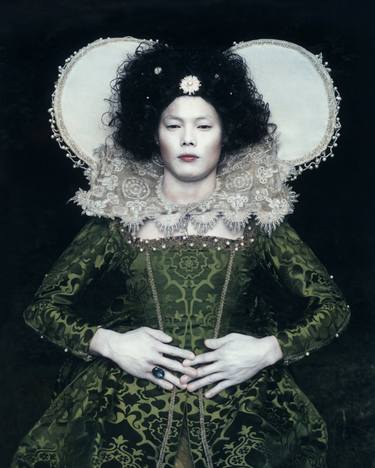
Lady Antonia Fraser begins the epilogue of her seminal 1969 biography on Mary, Queen of Scots with that ill-fated monarchs most famous words, spoken with pleading grandeur at her trial: Remember that the theatre of the world is wider than the realm of England. This notionthat the world and also history may act as percipient, compassionate spectators to any number of unjust actssuffuses not only Frasers biographical work, notably her Marie Antoinette: The Journey (the basis of Sophia Coppolas recent film), but also any given hagiography. Fraser herself would no doubt object to this comparison, for her intention is not to sanctify but to humanizeto make the vicissitudes of power, be they Cromwells or Henry VIIIs wives, vicariously contemporary. This is no small feat, especially in light of our visual record, those official portraits that so rarely convey the flesh and blood behind the pomp. Fraser is, in fact, intrigued by the ways in which the lives of her subjects subvert or at least comment upon the stiff conventions of royal portraiture. To flip through a pictorial insert in any one of her biographies and to read her accompanying captions is to get a good taste of the kinds of ironies of privilege she is trying to underscore. In Marie Antoinette, Fraser tells us that Louise Vige Lebruns depiction of the Queen in Rousseauvian country garb was criticized as indiscreet; another Lebrun showing the Queen and her children evinces a poignant, last-minute alteration, as Marie Antoinettes youngest child had died and had to be painted out of her bassinette. Similarly, a rendering of Mary Stuart, madeemblematic on covers of early editions of Frasers study, is described thusly, The Deuil Blanc portrait of Mary, by Clouet, probably painted in 1559 at the time of her mourning for her father-in-law Henry II. It is not surprising, then, that Chan-Hyo Bae has chosen the iconography of queenliness to express his own feelings of cultural estrangement. Originally from South Korea and currently living in London, Bae begins from very simple, common sentiments of foreignness. His workslarge-format colour prints, in which he plays unidentified female British monarchs from the thirteenth to the nineteenth centuries (all his works are untitled)initially appear to be a cheeky sort of wish fulfillment. One is readily reminded of Yasumasa Morimura, the Japanese artist who casts himself in Western arts biggest roles, and also, perhaps, of the phenomenon of cosplaythe subculture of dressing up likefictional or historical characterswhich originates in Japan but has become popular throughout Asia and the rest of the world. Bae seems to be performing a blatant paradox: that of the outsider gleefully destabilizing the hierarchies of a culture about which he has admittedly fantasized, but which has forbade him full entrance because of an unalterable ethnicity. Yet Bae also describes his Existing in Costume series as akin to what a child tries to do in dressing as an adult. Here Frasers contentions about Mary, Queen of Scots and Marie Antoinette can be brought into play, extending Baes project beyond simple-minded, postcolonial gunpowder plots. After all, what we see in Frasers biographical portraits is the utter ontological rupture present in the very idea of monarchy. The semiotics of royal representation have never been a stable means by which to express individualized character or subjectivity. Their very intention is to eradicate such things in service of nationalismto create, out of the monarchical body, a signifier belonging exclusively to the state and its people. The contradictions and impossibilities of this intention have been hashed out so many times in popular art as to become a secular humanist clich. From Shakespeare to Hollywood, we are inundated with representations of monarchs who fall out of line with, or rebel against, the psychological neutrality of their propagandistic representations. Royal portraiture and, arguably, royalty in generalis now not just synonymous with prestige but also with crises existentielles, melancholy, entrapment, martyrdom and, as Bae suggests, a tragic, protracted innocence. In Chan-Hyo Baes photographs one accordingly sees his identification with the Queen as a misfitas one who inhabits a role which she can never fully possess or understand. That he is cross-dressing merely stresses the point. He is not interested in queerness or camp; this is not sarcastic idolatry or a theatrical apotheosis of the feminine. Bae is simply, in his words, trying to express existence as another person. In the tradition of portrait posing, he carries with him items that speak to who he is, but which, in their own quiet strangeness, controvert any perceived act of intimacy: a fan (which might just as easily be a Western queens Orientalist flummery), a golden pig (a token of good luck), a birdcage that contains within it a red and a blue ball, presumably representative of the South Korean flag. Relegated to the symbolic realm, Baes self strains under its own, bi-polar weights. One senses an awkward distance, an ineffable repression, a longing gaze through a bizarre suit of armour. One photo, showing Chan-Hyo Bae in what looks to be a Rose Bertin pouf, speaks to the difficulty in ascribing to monarchy and its representations any degree of nationalist authenticity. Here Bae resembles the non-British Marie Antoinette, and may be Charlotte of Mecklenburg-Strelitz, the queen consort of George III. In any case, the hairstyle is patently continental, as were, appropriately, many of Europes queen consorts, who were effectively imported wives for the purposes of political maneuvering: Charlotte was from Germany, as was, for thatmatter, the House of Hanover. Marie Antoinette was Austrian, and in her book Fraser memorably describes the handing-off of the child bride, who was required to be stripped of her Austrian clothing, even of her pet dog, Mops, before crossing the French border. Mary, Queen of Scots, who also retreated to France for an early, arranged marriage (she herself was part French), had three husbands in totalthe last of which was the enterprising Bothwell, who abducted and raped her under the premise of her needing, for political reasons, to betroth a native-born subject. Mary, Queen of Scots story is of an outsider on the inside, of an itinerant woman bound to merciless concepts of empire. In what appears to be Baes depiction of her, he adopts red hair (this is atypical, for in all the other works he leaves his hair black)a trait that has marked her throughout history as echt-Scots. If this is a gesture of alienation, it is also one of firm alliance. In her recounting of Marys death, Fraser remarks that the Queens head was held up by the executioner, but that the auburn tresses in his hand came apart from the skull and the head itself fell to the ground; her actual hair at the time was short and grey, and she had chosen to wear a wig, along with a matching blood-red petticoat and bodice, for the beheading. Even in the audience of that wide theatre of the world, Mary had thought it wisest to exist in costume. … Read More
EXISTING IN COSTUME / FAIRY TALE PROJECT
We call western people’s fixed notion or a distorted view toward the East ‘Orientalism,’ which originated from the cultural prejudice in the West, and ‘Occidentalism is a comparative notion which makes a contrast with Orientalism. E. Said formerly criticized that both are nothing but false images that see other cultures from an ethnocentric viewpoint and this tendency has justified the western imperialists’ invasion against the East.
From a historical or social point of view, the difference of culture and language has been one of the most important standards that make a distinction between various social classes. Additionally, a war is one of the most significant factors that enable us to grasp the essence of the world history, and the social classes became more differentiated in this ‘weak-to-the-wall kind of society’ caused by the wars. It was the age of imperialism that accelerated this law of the jungle by force in a full scale.
H. Spencer’s ‘Social Darwinism’ is nothing other than the ideology that justified imperialism of ‘the law of jungle.’’ This imperialism ultimately brought about Orientalism that the West as a winner will understand the East as a loser from its prejudiced point of view.
Furthermore, this historical and cultural prejudice caused another prejudice against social positions in capitalist societies, transmitted from generation to generation by education or other social conventions. The prejudice against an Oriental male in the western society has been shown to me as an utmost form such as the feel of alienation or the chaos of identity. In other words, these emotions of mine are related to the prejudice mentioned above and personal worries which is due to it.
From my point of view, this prejudiced notion of the West is the most highlighted particularly in the western portraits. All the western portraits that I have observed are drawn by oil painting, and all the persons in the pictures seem to be described, following the direction that their superiority and tough spirits are maximized. For example, the portraits of the King Henry VIII or the Queen Elizabeth I that I saw are the ones that described the shapes of the aggressive people who had made a big contribution to building ‘the great England.’ Here I think that the skill of oil painting and the images of the people described by it are two essential factors that make it possible for me to approach the shape of the West because these points are so western that they are hardly shown in the eastern culture. In other words, oil painting has not been used in the eastern culture, and a typical eastern portrait drawn by water painting does not describe a person as an aggressive image. Thus, I have applied this western painting method to my photographic works in order to express my emotions of ‘alienation and prejudice’ in the world of my art. For instance, some distinctive features such as the strong color contrast, composition, the pose of the person and the background of the time which are shown in the one of my works, ‘Existing in Costume 1’ were inspired by these traditional English portraits.
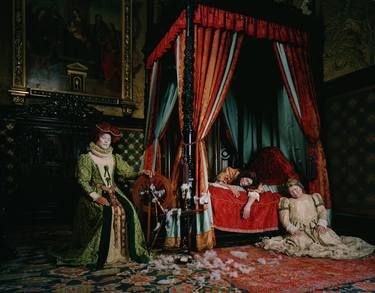
From now on, I intend to seek these notions from the stories of the heroes or the heroines in the traditional western fairy tales, as a link in a chain of the efforts that aim at developing my works more than ever. In other words, in the first half of my activities, though the motives used in my works were from history, those in the second half will be based on traditional western fairy tales. It means, although the philosophy in my works will be the same, I will pursue the materials for expressing my emotions in another place. Furthermore, it indirectly exposes that the feelings of ‘alienation and prejudice’ that I have coherently claimed exist everywhere in the western society.
I think that both history and fairy tales share a common point with each other in that they lead their readers to accept a fixed conclusion or thought. In other words, ‘describing the history as it used to be’ which had been claimed by L. Ranke in the 19th century became turned out to be false, and history is nothing but a story which describes ‘a historian and his facts’ as what E. H. Carr claimed. Thus, describing history in present age goes to the direction that denies a historian’s ‘grand narrative’ like what J. Derrida claimed by his notion of ‘deconstruction.’
From this viewpoint, I claim that narrating a fairy tale is quite similar to describing history in that it tends to unwittingly infuse a fixed virtue or a formed frame of thought to the readers who experience it. Therefore, for me to convert the source of my motives from history to fairy tales does not break the consistency of the philosophy in my works.
I have examined some representative western fairy tales for my new activity; for example, Cinderella, Snow White, Rapunzel, Beauty and the Beast and so on. What I found in them is there are definite social classes in these stories, and all of them contain tacit messages that the weak should obey the order designed by the strong in order to enjoy happiness. This point corresponds to the historical fact that the powerful western countries intended to strengthen and solidify their regime in the conquered countries by indoctrinating their governing ideology to those whom they ruled. Thus, on the extension of my working activities in the first half, I am to reinterpret these notions hidden in the western fairy tales and use them as the important motives for my works in the second half.
By Chan-Hyo BAE … Read More
Chan-Hyo BAE was born in Busan, South Korea and has graduated MFA Slade School of Find Art (2007) in London and BA Photography in Kyung-Sung University (2003), Republic of Korea. After his moving to London in 2004, he has been living and working in London. His works has been shown in several international exhibitions and fairs include Chaotic Harmony, Santa Barbara Museum of Art, USA, Korean Eye: The Fantastic Ordinary, Saatchi Gallery, London, UK and Ruptures and Continuities, Museum of Fine Arts, Houston, TX, USA. His work has been Collected in Santa Barbara Museum of Art, USA and Museum of Photography in Seoul, Korea. … Read More