rumi samadhan

rumi samadhan


About

The Artist as-Eco Warrior

Rumi Samadhan is a crossover artist. As the compartments between high art and popular culture continue to break down we find more artists, who bridge the two worlds of fine art and advertising, making inroads into what was once seen as a ‘sacrosanct’ space, available only to those who practiced ‘art for art sake’. Graphic artists like Takashi Murakami and in India, the late Goan artist Mario Miranda, often find themselves on the cusp of this debate and their work is viewed through the prism of crossover art that embraces both the popular and the niche.

As the 34-year-old Rumi makes her debut into the world of fine art, from that of advertising, one must keep in mind that the strong graphic quality of her work and the directness of her metaphors, come from the school of thought that is primarily geared towards communicating with a wider audience.

Her references, however, are more oblique in quoting the influences of popular culture, unlike Miranda or even Murakami. Her influences in fact range from American feminist artist, Kiki Smith to India’s humanist and new media artist, Shilpa Gupta. Rumi also admires the works of Ghana-based artist, El Anatsue who works with both natural and man-made waste elements. Like most artists working in the realm of advertising, she respects the work of S H Raza, whose geometric ‘design’ -based work has appealed to both fine and commercial artists for its clean cut understanding of form and colour.

Rumi’s approach to art is also guided by the Japanese aesthetics of Wabi - Sabi, which, when translated, means a coming together of sleek modernism tinged with rustic Zen-like chaos. This aesthetic ideology draws its roots from the Buddhist philosophy of the three marks of existence, specifically: impermanence, suffering and emptiness or absence of the self. In a more corporate world, the Wabi – Sabi approach has been defined as the space where technology reminds us of our own humanness. These influences are not immediately apparent in her art work but it gently filters through as an underpinning philosophy as one engages more with Rumi’s work.

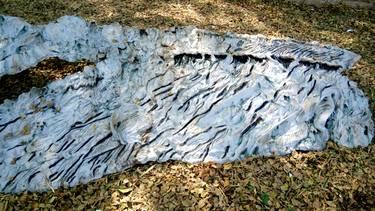
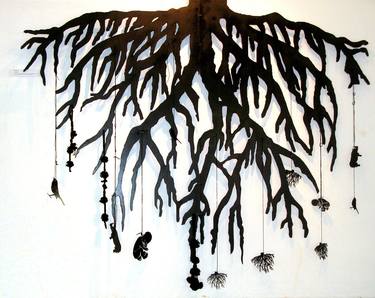
Her native place Goa holds nature in its lazy embrace and is rich with its references to its Portuguese past. Some of these influences permeate much of her work. However, the multicultural twenty-four- seven city of Mumbai, where she has grown up and spent most of her working life, brings the important contrast of the globo-local art scene to her work. Her installation, titled Roots, indirectly hints toward this merging together of sensibilities.

Rumi recalls that she was drawn toward the arts at an early age, where she found herself scribbling in school books, like many contemplative children often do. This desire to put down on paper what she values, cherishes, loves and detests grew into a more serious preoccupation when she chose for herself a life dedicated to the arts. Fuelled by this passion, for much of her adult life, she found herself creating a parallel world that looked healthier and more manageable through the act of painting.

This exhibition took a year to create and consists of a suite of 25 paintings. Her primary concern is the face-off between mankind and nature. Her endeavour is to understand this delicate balance and unite the two forces in her mind and on her canvas. Nature and technology are the twin tools that govern human life and while they have been in a constant tussle with each other, one cannot imagine the world we live in without either.

Hence, while Rumi as an artist, is inspired by nature, and is pleased by its various shades and textures, from the colour of dried leaves to stones and twigs, she feels a sense of disquiet when confronted with the hyper materialism of our technologically driven, dehumanised society.

While the essence of life and the people around her fuels her inspiration, she is also fascinated with the balance of Yin and Yang, (good and evil) and the life forces, of Eros and Mars that tinges our ordinary lives, making them extraordinary. Ironically this struggle elevates our mundane existence to that of survivors and eco-warriors in this constant battle of creation and destruction.

Rumi’s meticulously executed oil-on-canvases display a restraint and maturity in their use of primary colours of black-and-white. While the light and dark is symbolic of these two aspects of life, her use of reoccurring motifs like fœtuses, seeds, roots and implements of war and violence allude to the contrasting forces of Eros and Mars birth and death.

These dualities manifest in works like Germination, the Conscience Series and her Erosion and Roots installation. The format of the works range from intimate two foot canvases to larger eight-foot works; some of the installations are four to fifteen feet in range.
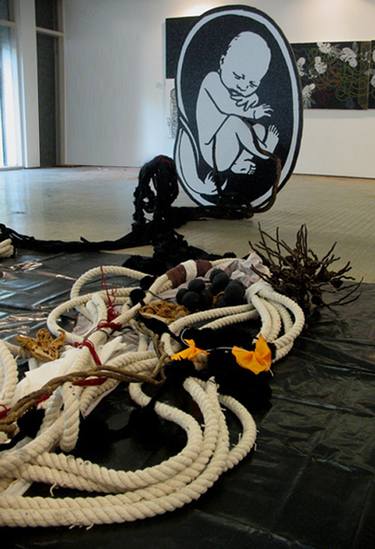
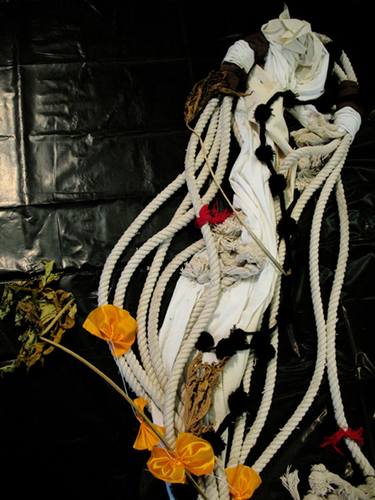
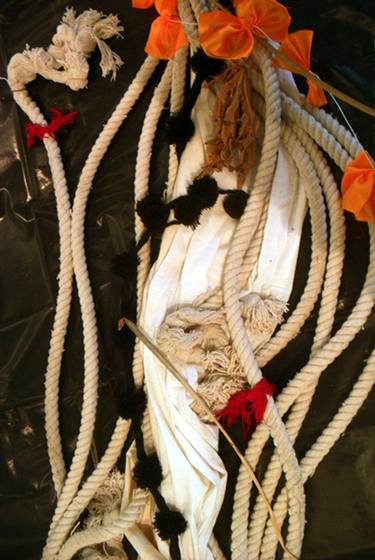
The installations are executed in a fusion of various materials, threads, and rope and other materials like metal, board and acrylic cut-outs.

The artist chose to work with rope and thread because of its ability to symbolize the invisible bond between man and nature and between a mother and her child through the umbilical cord, which arguably extends long after birth. The fœtus also acts a metaphor for the innocent self, untouched by the ways of the world, while the umbilical cord as a multi-connector, which is a life sustaining bond, with the supreme source (God) and other natural elements in her images.

At times we see them embellished with roots and branches, where roots become emblematic of growth and expansion. Roots also allude to a strong foundation and a sense of substance and value, a sense of curiosity, a need to search and expand.

Seeds are symbols for the potential trapped within an individual waiting to burst out. It is the life nurturing sap that nourishes human kind and is linked to several creation and birth stories in various cultures.

Celebrating this life-force are images of the bird in flight, an explosion of flowering flora that complete their life cycle from cell segments to full-fledged plant life. Rumi visualises the universe as the womb, the cosmic egg from which all creation is born.

In her installation, Erosion Rumi has used images, of soldiers at war: From Japanese soldiers to Indian warriors, camouflaged army men to dark clad terrorists. In many instances she has repeated the images till they look like clones of each other, assembled in one big army. They are emblematic and representative of men at war over generations. The artist makes a statement that challenges war, imperialism, masculinity and its ramifications on nature.

Notions of justice, pride and revenge needs to be problematised along with the smugness associated with medals handed out to war heroes.
If the apparatus of earning these are multiple killings,
then, Rumi rationalizes, terrorists and enemies of state could also be seen as freedom fighters. The installation, speaks of the displacement of innumerable families that find themselves unwittingly placed in the pathway of these conflicts.

In this scenario the threat of nuclear warfare is just a trigger away, and the super volcano or nuclear winter might just become a turn of the season, as the culture of hate survives in various forms, eroding basic human values.

Georgina Maddox
(Independent art critic/curator)
Read More
Location
Mumbai, India
Education
1999,Diploma in Applied Art, Sophia Polytech, Mumbai.

Solo Exhibition-

2011, "Invisible Connections" an exhibition of paintings and installations.

Participation:

2013, Palette, charity auction for Edelgive Foundation, Mumbai.

2013, Mumbai vibe, an installation for BMW Guggenheim Lab, Bhau Daji Lad Museum, Mumbai.

2012, Confronting Comfort, curated by Maria Nicanor, BMW Guggenheim Lab, New York.

2012, Mumbai artists paint for Jehangir art gallery for the Celebration of Diamond Jubilee.

Awards-
1999, Trophy for best Creative performance of the year, Sophia Polytechnic.

1999, Rotating trophy for Best Campaign, Sophia Polytechnic.

1999, Silver medal for Best Campaign, Sophia Polytechnic.

Email- rumisamadhan@gmail.com


Read More

Friends

View All
  • Jonathan Brilliant
  • Andrea Silva Guzman
  • David Dimichele
  • Brooke Mullins Doherty

Roots
Unifying existence
Unifying existence
Unifying existence
Unifying existence
Unifying existence
Unifying existence

loading

Favorite Artists

View All
  • Brooke Mullins Doherty
  • David Dimichele
  • SAATCHI ONLINE
  • Charles Saatchi

Favorite Art

View All
    Pseudocumentation: Branch Drawing
    Rudiment
    Proliferación 03
    Sin titulo
    Hold