Dinajpur, Bangladesh Dob: 1970
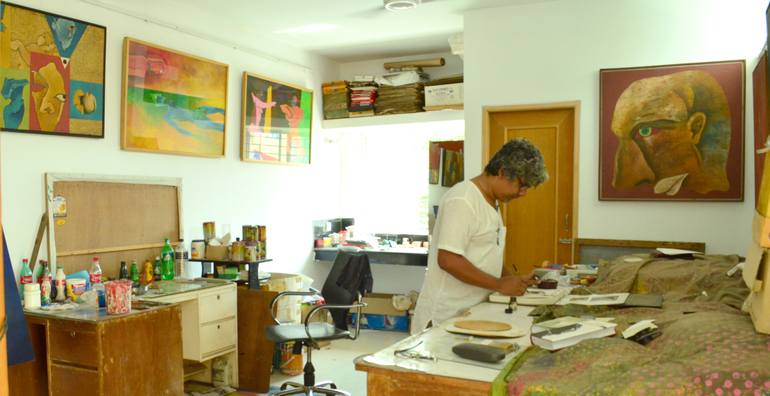
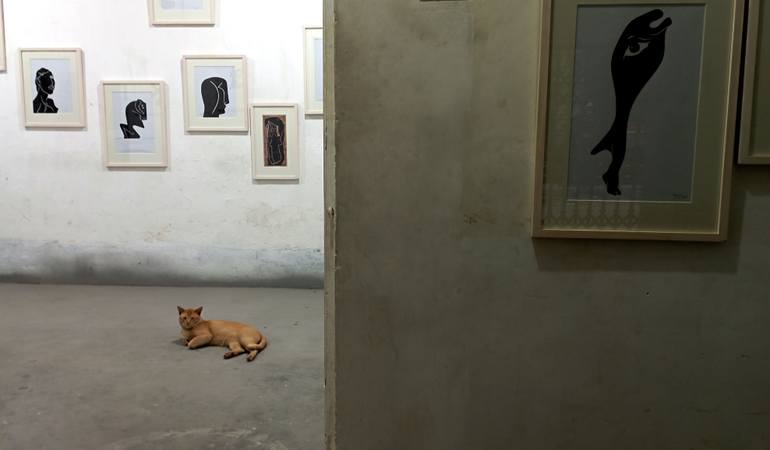
A glance at Najib Tareques works can leave a viewer confused for sometime, and that, as the viewer gradually realizes, is the essence of his paintings. This does not mean that his works are confusing in terms of technique or subject; in fact what Tareque does is picks us up and sets us loose in our own world a world full of contrasts, conflicts, confusions, motions, and intense emotions. Where Bangladeshi artists always face the restraints of a contemporary trend or technique, Najib successfully maneuvers around this fixation on craftsmanship and emerges with intellectually sound paintings that advocate for freedom and individualism, and with no less finesse than any of the ace painters of the country. His inspiration from cubism is evident in the geometric shapes, distorted lines, and the almost three-dimensional colors in his paintings. His works contrast and combine historical or mythical figures presented in modern forms, the conflicts of the heart and the mind, and the tension in a society arising out of the prescribed versus desired roles of men and women are all present in his works. Another very remarkable expertise of Tareque lies in his courage to bring out the atavistic side of human nature. Thus figures in his works are seen agape and thrilled with a wondrous fear; and the all-seeing eye present in many of his works both mocks and terrorizes us. The spaces on his canvas throb with the stasis of motion and inertia, while the figures that float on them wear a wide array of emotions all at once. It is moments he captures, moments of stagnation, moments of sexual complexes, and moments of desires all at play as parts of a greater, sublime design.…Read More