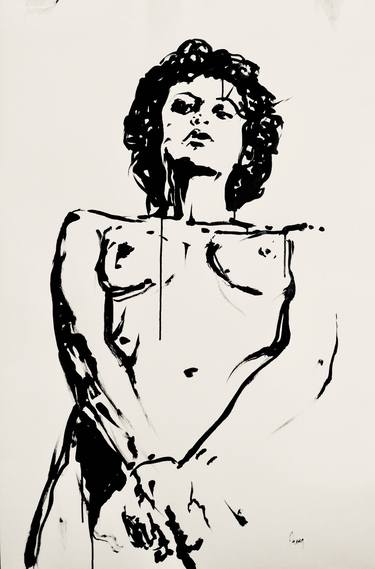
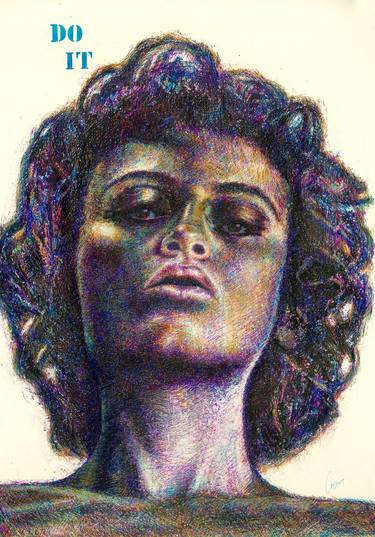
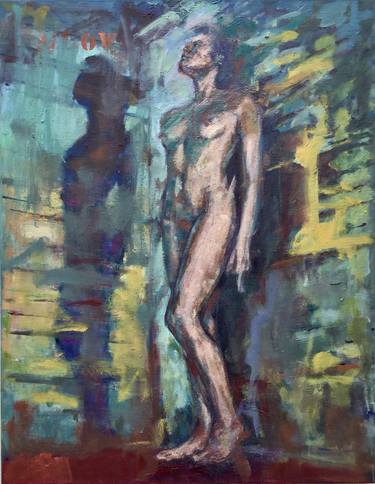
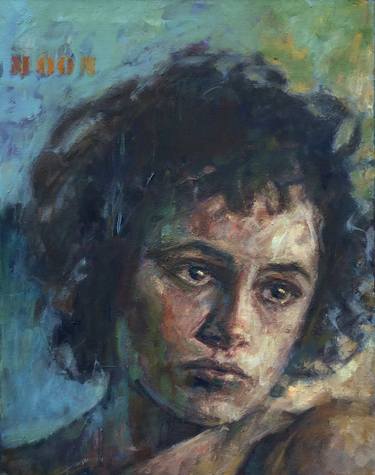
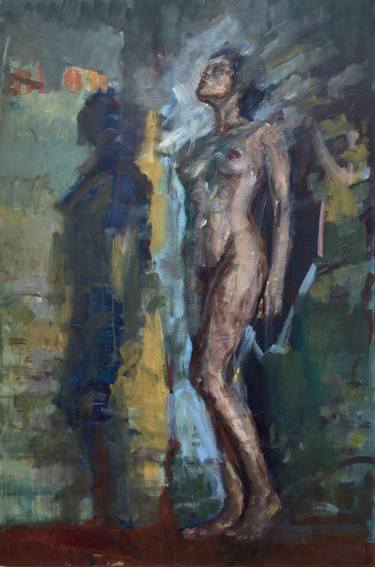
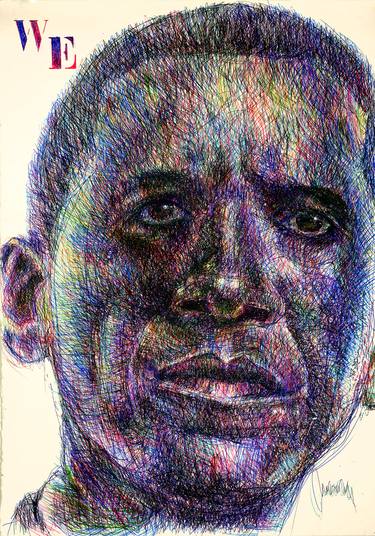
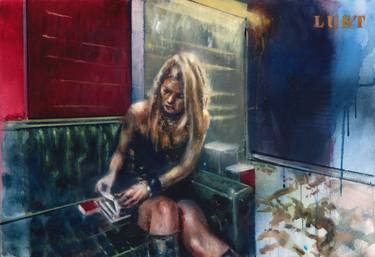
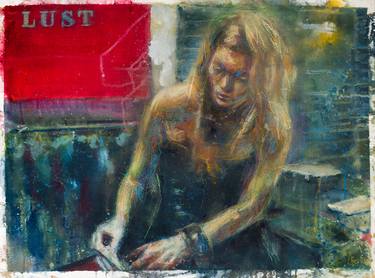
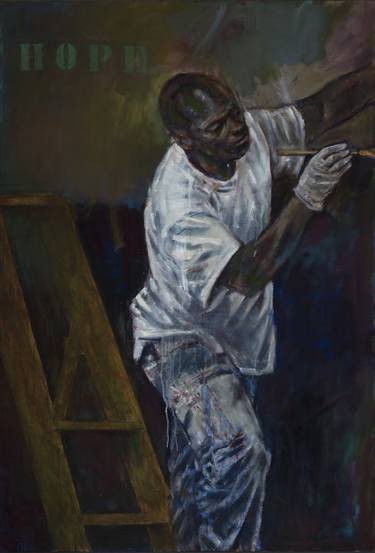
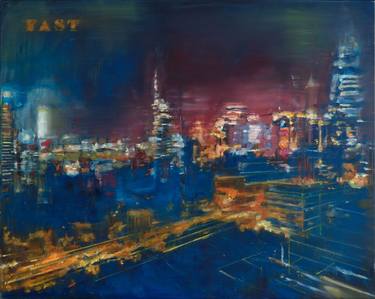
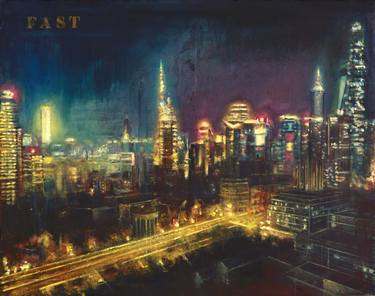
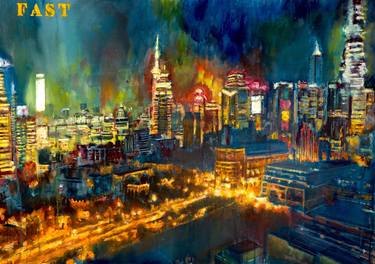
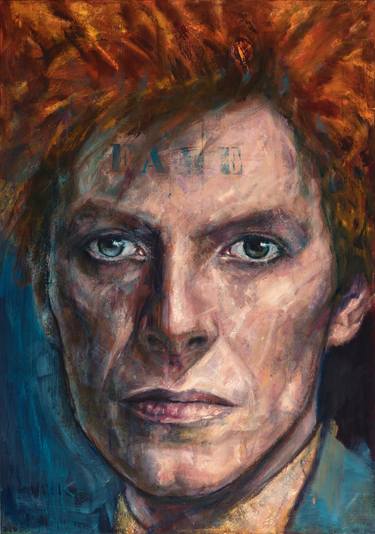
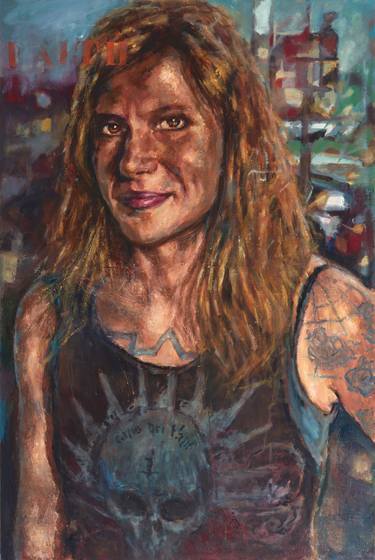
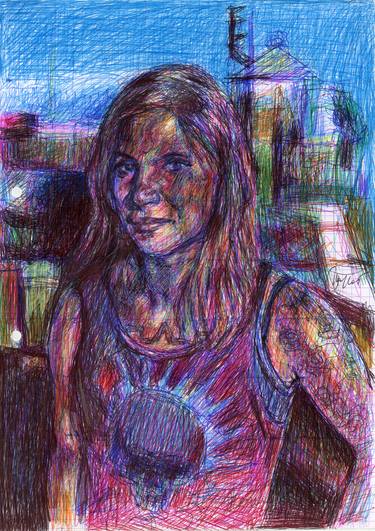
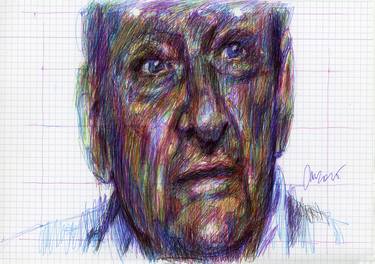
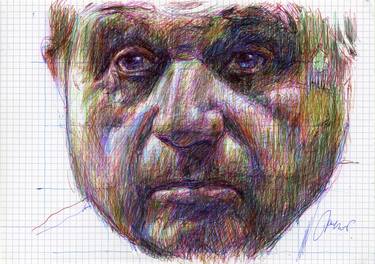
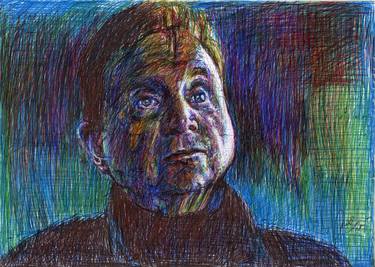
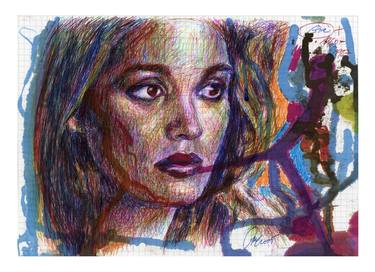
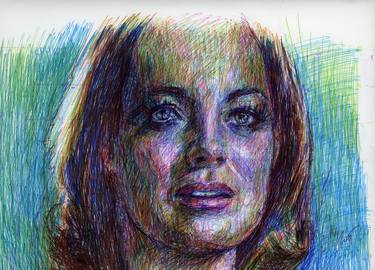
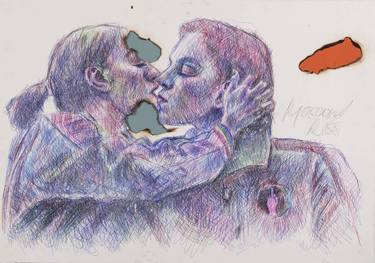
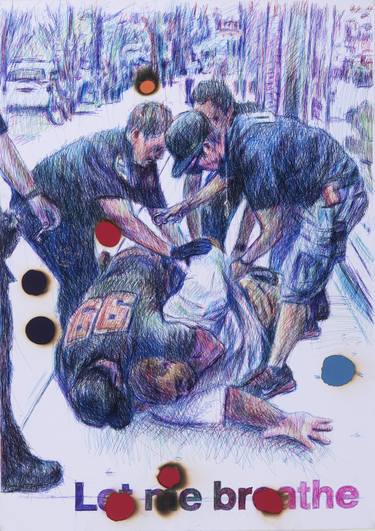
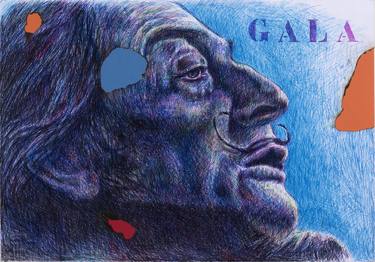
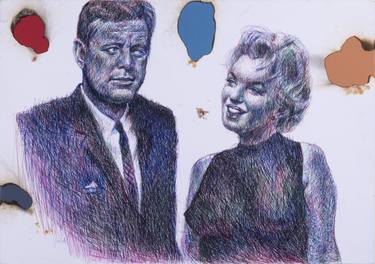
The Geology of the Subconscious The gaze of this young woman that is so intense we lower our eyes; the haunting familiarity of her face, conjured up a thousand times in the mind's eye, and different each time; the sensuality of her figure, whose chiaroscuro traits linger as beauty and desire tug for possession of the viewer's mind: all these go to make up Bertrand Neuman's world, a world we enter with that curiosity mingled with mild misgivings that assail us when we visit a portrait gallery. Memories are awakened, feelings aroused, intimate moments rekindled, forgotten faces flash back. Like "vanities", those paintings of another age, the portrait brings home the painful message that all is transient and destined to fade. Contemporary artists usually paint portraits only occasionally. For Bertrand Neuman, portraying the human face has been the abiding concern ever since he started painting. "For me," he says, "the portrait is the very architecture of life." His fascination with the human figure focuses on the face's infinite variability and he draws his inspiration from the inexhaustible well of emotions it holds and generates. In it one can feel the throb of life and sense the subconscious breaking to the surface, now expressed, now repressed. That is why Neuman's portraits are often divided into two distinct sections dominated by shadow and by light. This recurring structure works on the alternating pattern of revealed and concealed elements. In architecture, the succession of revealed elements and shaded areas, most simply expressed in the colonnade, gives the structure rhythm by a process as old as civilisation. The eye first picks out those foreground elements on which the light falls. What lies in the shadow is perceived later as the beholder gradually takes in the overall complexity of the picture. The faces that fill Bertrand Neuman's canvases express this duality in manifold ways, and all the more boldly and consummately as the artist dominates his art. Where his hand is sure, the artist's mind can express itself without constraint. And even where he fumbles to express an idea before finding the right way, his hand and mind are in tune at each phase of the act of creation. As well as calling on the subtle interplay of light and shade, he works by applying layer upon layer of paint. When he works in oils, the face emerges slowly as each layer is added. An X-ray of one of Bertrand Neuman's paintings would show what appear as geological strata that have built up slowly as the work has matured. One series of the artist's oil-paintings shows how he has separated the different phases of development, presenting them side by side in the form of vignettes. Each element of the mosaic the variations in light, the alternating backgrounds, the shifting volumes is an achievement in its own right and gives the whole a unity that owes its equilibrium to both the diversity of the representations and the unity of the subject matter. By decomposing and recomposing the subject in this way, his basic aim is to create a close link between subject and painter, a link that goes far beyond the limits of mere representation. Though he never lapses into illustration or caricature, Bertrand Neuman steeps the distinctive traits of his faces in colour, overlaying them with streaks and dashes of paint to enhance their impact. As if born from chaos, the faces emerge slowly, at times eerily. In other compositions, he paints solid black or white contours around them or daubs colour over certain features with passionate, almost violent brush-strokes. In his search for new effects, alone or in combination, Bertrand Neuman has experimented with various techniques. He has a preference for oils, but water-colours and Indian ink have opened up new horizons for his talent. In addition to traditional canvas, he often works on paper and plexiglass. In each case, the medium and the support are selected with a particular objective in mind. The paper he uses for water-colours is highly permeable so it can soak up the colour completely. Unlike most artists who employ this technique, Neuman superimposes layers of colour to create merging, intermingling, dense shades, sometimes enhanced with black. In his small water-colour representing the actor Paul Newman, the face is suggested rather than drawn in a mosaic of hundreds of dabs applied to a paper with a velvety texture reminiscent of tapestry. Plexiglass is rarely Neuman's main support. Instead, he uses it to paint lines and contours which are then superimposed on a white ground or on one treated with water-colours or oils. The few centimetres that separate the two planes give the work a depth which is rendered more intense by the projection of the drawing onto the background. In this way, he produces a unique, coherent picture created from two representations executed by different techniques. The background is occasionally coloured in like the rough geography of the face. Sometimes it is no more than a sort of chromatic landscape against which the features stand out.
Bertrand Neuman was born in Brussels in 1967. His father is the sculptor Nat Neujean, which means that from birth he lived in surroundings that were favourable to an artistic vocation. When he was seven, he started drawing, but his true education in this art started when for three years he studied in the section artistic humanities of the Brussels Academy of Fine Arts (1984-1987). He learns to draw after nature and is fascinated by the comic strips because of the precision and the effectiveness attained by the use of a pen or brush. At the same time, in 1986, he works under the painter Ari Mandelbaum at the Arts School of Uccle, a suburb of Brussels. Even before he starts his studies, Bertrand Neuman knows intimately that drawing is the basis of everything in the field of the arts. He devours books on anatomy, practises drawing from memory and makes an endless number of sketches and projects, which is the reason why he considers himself primarily as a self-taught artist. From the age of thirteen or fourteen on, he spends long periods with his parents in Italy, especially in Florence. This gives him the opportunity to meet a number of artists among whom the Czech painter Mikuls Rachlk who may well be accountable for his artistic vocation and for his fascination with the human face. From 1987 till 1989 he studies at the Studio Cecil Graves in Florence. He is trained there in the preparation and the handling of pigments and bearers; he perfects his know- ledge of human anatomy and does studio work. But he will remain rather sceptical as to what is taught him: he will retain only whatever enables him to develop a personal style, without jeopardizing his originality. In 1988 he follows the courses at the Summer School of the Arts Student League in New-York. Strangely enough, the teaching which is offered there stresses the techniques of the French naturalist painters of the 19th century and of the new American figurative school. As this is a kind of return to the sources of traditional representation and techniques, it cannot but be profitable for him. While visiting the United States in 1988-1989, Bertrand Neuman spends some time in New-York, Dallas and Arizona. He witnesses the last manifestations of the pop art movement and discovers an artistic colony that is unknown to him in which the personality of the artist takes precedence of the work. Andy Warhol will influence him through his powerful colours and his inaccessible but eternal portraits. After his return from Italy, Bertrand Neuman will go through a long period of isolation that has strongly contributed to the deepening of his present work. Since 1995 he has been living permanently in Brussels. Didier Paternoster Art Historian …Read More
Bertrand Neuman was born in Brussels on 10 June 1967. He began drawing and painting at the age of seven. - 1980 to 1985: studied properties of colour and composition under Czech painter Mikuls Rachlik in Florence. - 1984 to 1987: art studies at Acadmie Royale des Beaux-Arts, Brussels. - 1986: course at Uccle Art School under Ari Mandelbaum. - 1987 to 1989: studied techniques of Italian Renaissance and new American figurative school at Studio Cecil-Graves, Florence. - 1988: worked intensively at painting portraits and models in David A. Leffel's studio at Arts Student League, New York. - since 1988: has made frequent trips to United States, visiting New York, Miami, Tucson (Arizona) and Santa Fe (New Mexico), where he has worked on commissions from private patrons. - 2001: worked at his monograph, to be published in 2004. - Now spends his time partly in Florence and partly in Brussels, where he is currently based. - Many private collections in Belgium, France, Italy and the United States contain works of his. - 2008: He had a show in Brussels with his father the sculptor Nat Neujean.
Group Exhibitions:
1989 - A travers les chansons de Brel in house where Brel was born and at Maison de la Culture, Ath. - 1789, An 1 de la Libert, Galerie du Parvis, Brussels, under the aegis of the French Ambassador; guest of honour together with Roger Somville. - Took part in "Libert, Egalit, Fraternit etc.. A competition organised by the Ligue des Droits de l'Homme. 1990 - Together with Louis Rives, designed set for Broadway musical (Shapiro Theater), New York. - Alta Gamma, Brussels. 1991 - Paule Deboek Fine Arts, Ghent. - Awarded Commune dUccle Prize for Painting. - Galerie Tempera, Brussels. 1992 - Paule Deboek Fine Arts, Ghent. 1992-93 - Lineart, Ghent. 1993-94-95 - Galerie LHomme qui rit, Brussels. 1996 - Kunstgalerij Ernest Verkest , Tielt, Belgium. - Galerie des Beaux-Arts, Brussels. 1996-97 - Expo Start, Brussels, Antwerp and Lige. 1999 - K Gallery, Brussels. - Lineart, Ghent. - Grand March de l'Art Contemporain, Brussels. 2001 - In Art We Trust, Miami. - Awarded P.L. Weiler Portrait Prize, Institut de France, Paris. - Parcours dartistes, Brussels. 2003 - EventSFR, organised by ROUGE, Ddicace Caf, Paris. 2008 - Itinraires XXIX, Galerie Albert 1er, Brussels. 2009 - The Dark Show at Nolias Art Gallery London
Individual Exhibitions
1989 - Galerie Eresie, Florence, Italy. - Halles St Gry, Brussels. 1992 - Galerie lHomme qui rit, Brussels. 1993 - Palazzo Rossi Proghi, Florence, Italy. 1996-97 - Private exhibition with sculptor Nat Neujean, Brussels. 1997 - Kunstgalerij Ernest Verkest , Tielt, Belgium. 1998 - La Chocolaterie, Brussels. 1999 - Absolut Vodka-Redbull, Hippodrome de Boitsfort, Brussels. 2001 - presentation of Rochas perfume Anna Sui, Monkey Club, Paris. 2003 - Rosa, Brussels. 2005 - Galerie Ransbeck, Ohain, Belgium. 2007 - Private exhibition, Brussels. - Tribeca, Brusels. 2008-09 - Exhibition with his father the sculptor Nat Neujean at the Galerie Albert 1er, Brussel.,…Read More