Damion Hampton
Damion Hampton

About

Damion has exhibited paintings at the Annual National Students' Exhibition at the Mall Galleries in London in conjunction with the Royal Society of British Artists (RBA) had a painting exhibited at the Christies Student exhibition, London and recently been involved in assisting performance artist Alicia Wilcox. He has also been involved in public art at the Folkestone Triennial in Kent (2011). He recently graduated from the University for the Creative Arts, and plans to continue through to PhD level.

Artist's statement: 

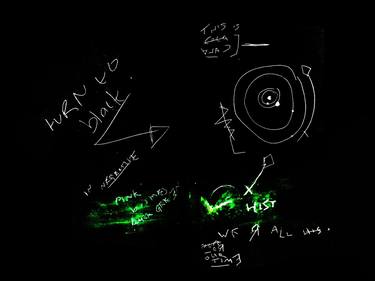
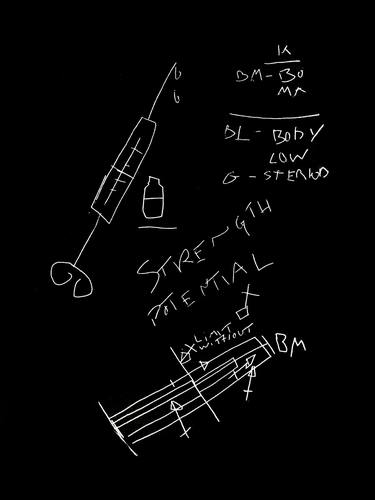
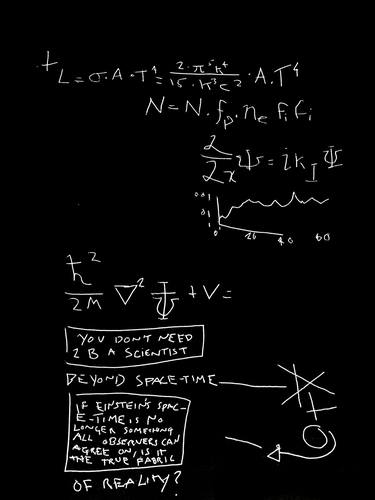
Elements of the work could be considered a kind of pseudoscience, the theorisation of unanswerable questions in science. In the context of painting I am interested in two key elements: The composition of materials and the textual discursive affects in terms of diagrams, text and organising text. Together these form the semiotics of my work and have an affect on the viewer. The work can be decoded in different ways, which is unique to each viewer. The information is shorthanded but not all of it is important. Work being reproduced in this manner tricks the viewer into thinking the work is meaningful.

The shorthanded information is gathered up from my own personal experiences with the world, daily interactions and general interests of mine. I record experiences in the form of note taking and voice notes.

The nature of the work is forms of consolidating information. This method of making work makes information more efficient by creating a shorthand version. I use gathered information like found objects, recomposing them onto canvas in a shorthanded version until the visual qualities are realised. I continue to paint until the act of painting takes over at which point I become much more interested in the form of the written language.

I have started to explore the theme of the project by constructing information into the painted surface. I am also interested in the relationship between text and materials. I start the paintings with different types of information in the form of diagrams, words and statement’s. I then compose them onto the painted surface until the act of painting takes over. I am very interested that the text is replaced by a drip of paint. As a result of recomposing short hand information and the process of reworking the painted surface the painting collapses “in metaphorical terms” to reveal new forms of information. This is a process of shifting, changing, covering up, layering and removing information gathered from my personal life until the final image is revealed. This process is my methodology in terms of construction.

As a result of this process the work produced looks like a whole load of information which can be decoded and understood, but that’s not the case. This is a question of how semiotics operates within the painted surface.

Semiotics, in general is a term used for the study of signs and how they become meaningful. In terms of the art object and Jean Francois Leotard’s explains, these are signs/objects that exist outside of communicative language and are different from cultural objects. In contrast, Meaghan Morris argues that the art object exists on the periphery of communicative language and underpins the way we experience everyday cultural objects. I would argue that the art object has a place in both sides of the argument. My own practice exists on Morris’s periphery, still inside the communicative realm of language. My work can still be understood in terms of codification. In contrast to Keith Tyson’s work, Tyson could be considered a good example of an art object moving between the periphery of language into Leotard’s sublime and back again through Morris’s language barrier. Tyson’s work cannot always be directly read in terms of semiotics and sometimes appears abstract. Sean Scully’s work however is abstract and belongs in the sublime. Because of this abstract nature, communicative language cannot be used to explain Scully’s work, it therefore, belongs in Leotard’s sublime.
How semiotics operate within the painted surface is important to understand within my own practice and how the relationship between the signifier and the signified can be understood in terms of Leotard’s explanation of semiotics in the realm of art and the art object. The understanding of semiotics will help me to understand the relationship of my practice in terms of contemporary art practice.

In contrast, to my own practice, American artist, Jean Michel Basquiat, paintings operate in a different way. The surface is worked the until the painted image takes over so much, that the language becomes almost completely abstract and collapses in terms of semiotics, there is no direct message left to decode, Basquiat becomes less concerned with the signifier and the direct narrative in terms of linguistics. Similar to my own practice the text becomes a diagram and not just the meaning of a word. The text becomes taken over by the construction of art and the deconstruction of information. This is a question of paintings importance when constructing the painted image.

As I've explored the project I've become less interested in Basquait’s method of construction and more interested in American artist Robert Smithson and his pre-sculptural diagrammatic sketches. Smithson’s diagrammatic sketches represent thought, a process of organisation, this is shorthanded information so it can be easily decoded and constructed into a 3D art object. Smithson is also a crucial artist to study as he was dealing with similar issues, the efficiency of short handing information.

Email: damionhampton@live.co.uk

www.damionhampton.com
Read More
Location
Canterbury, Kent, United Kingdom
Website
http://www.damionhampton.com
http://www.facebook.com/DamionGeorgeHampton
http://www.indiegogo.com
Work
Currently working at the Sidney Cooper Gallery in Canterbury,
Gallery Warden and reception (part time)

Artist: painter, sculptor and photographer
Education
Future education PhD Fine Art 2013-2016

MA Hons Fine Art 2011-2013, University for the creative arts, Canterbury.

BA Hons Fine Art 2008-2011, University for the creative arts, Canterbury.

NCFE level 3 in Graphic Crafts 2006-2007

BTEC diploma in Fine Art 2006-2007

Graphic design (A level) 2004-2006
Fine Art (A level)
3D design (A level)

Soapstone carving (AS level)
Graphic design (AS level)
Fine Art (AS level)
3D design (AS level).
Read More
  • Create an account with Saatchi Online to connect with Damion Hampton.

    If you are already a member, Login here.

Portfolio

Learn More

A portfolio is a group of works created by you, the artist, which feature at the top of your profile.

Damion Hampton
  $43
Damion Hampton
  $43
Damion Hampton
  $43
Damion Hampton
  $59
Damion Hampton
  $59
Damion Hampton
  $43
Damion Hampton
Damion Hampton
Damion Hampton
Damion Hampton
Damion Hampton
Damion Hampton
Damion Hampton

Collections

View All
Learn More

Collections are groups of images curated by you and your fellow artists and art lovers. A collection can include work from a single artist or from several different artists.

To Create a New Collection

Click on "Add a Collection" link in the Collections section of your Profile page or click on "Collections" from the top menu and then click "Create a New Collection."

To Add an Image to a Collection

Click on any image to get to the Image Detail page. Below the image, click on the "+" sign to add the image to an existing collection, or create a new collection for it.

loading

Wishlist

View All

    Liked Users

    View All
    • Luca Lupi
    • Damien Hirst
    • Willie Hoffman
    • SAATCHI ONLINE
    • Jianfeng Chen
    • Mathieu Bernard-Martin

    Liked Art

    View All
    • Untitled
    • Redemption for crocodiles
    • Peasants 1
    • APHONE
    • Tribute-n°1
    • Sanctify

    Wishlist

    • Loading...
    ×