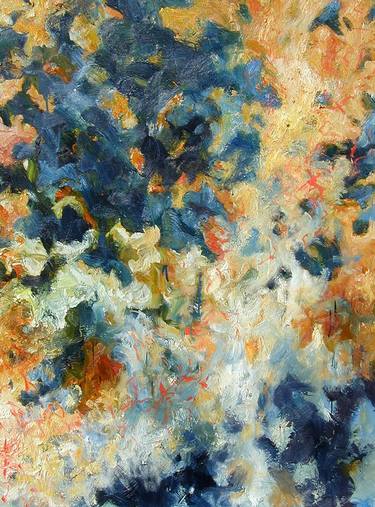
I WAS BORN IN MODESTO IN 1929 AS LAVIDA JUNE HUNT, AND I DREW AND PAINTED FROM THE TIME I WAS OLD ENOUGH TO HOLD A TOOL.
My mother remarried when I was five and we moved to Redding, California, where I attended school,and was fortunate in having gifted and dedicated teachers throughout my school years: they always gave extra in whatever field they taught, and I have never forgotten them.
My mother, a piano teacher, gave me music lessons and accompanied for a local dance teacher to pay for my classes with her. We performed often for clubs and schools.
I was a quiet child, loving to read and to be with my cats. The dance classes surely helped me to become more sociable, and later music lessons certainly gave me a "work habit" and a self-discipline that I feel has been essential in my art fields. Eventually even the simple ability to be alone for many hours at a time has served me well, especially my solitary day trips, from age 7 or 8, into the hills behind our house, carrying a lunch and often not returning till suppertime. Nature has always been important to me.
Gardening now helps give me the contact I need with the earth, now that camping is more difficult. One of my earliest memories is the wonder of digging up warm potato-bodies from my grandmother's garden during the Great Depression (1929=36).
ALL THESE THINGS BECAME THE BASIS FOR MY ART AND STILL APPEAR THERE. I do not paint "to express myself," but rather, to maintain contact with something far greater than myself. I follow a life thread, from work to work, and never know where it will lead me.
JENNY HUNTER GROAT has had formal training in Music, and full art lives in Modern Dance/Performance Arts,western Calligraphy, and now Painting, which she feels will be the major focus for the rest of her life. But she also makes Artist's Books, some collage, and, as she says, "I play with my friends online" in various Mail Art projects. Occasionally she writes the poetry or texts that she puts into her artwork.
She says, "It may be that I worked backwards, and should have been in the Painting world from the start, yet each of my art fields has contributed to what I do now. My paintings are a synthesis of what I've done in my first fields."
SHE FOUND HER INSPIRATIONS AT FIRST IN HER TEACHERS. She was inspired by her high school art teacher, Beatrice Kempf, who, in Groat's opinion, gave her students the equivalent of a first year art school education.
In College, she discovered Modern Dance and movement improvisation, through Marjorie B. Sheridan, which sent her into her Modern Dance career. The improvisation has been so important that she has kept it alive in each art, though she is more likely to say, "It kept my art alive."
Dancer/Artists, Welland Lathrop, Anna Halprin and Merce Cunningham have helped shape her dance work and indirectly, her painting now. The painters that have most inspired her tend to be those providing the vitality of the great Abstract-Expressionist movement. She grew to artistic maturity in San Francisco in the 1950's, immersed in the excitement of this time on both coasts and enveloped by the influences of the Golden Gate as "The Gateway to the Orient." Favorite artists are still John Saccaro,Robert Motherwell, Jackson Pollock, Pierre Soulages, Helen Frankenthaler, and Joan Mitchell. Earlier artists who inspire her are Van Gogh and Monet, "who thought of it all and had courage then, as do my more recent choices. Besides their courage I love them all for their boldness and gesture. There is such a thing as 'truth' in a line or gesture, and they all have had it. I strive for it."
IN THE 60'S, GROAT MADE SOME WORKS THAT PROTESTED THE VIET NAM WAR. But she has now turned away from "protest" and other "political" artworks, saying, "I am older. And I have experienced other things, too. I've now had to move on to where real answers may be found, in the hearts and spirits of us all. I want to put something positive into an essentially negative current world environment."
THE WORK COULD BE CALLED "SECOND GENERATION ABSTRACT-EXPRESSIONIST."In Calligraphic artworks, she put words into varied painterly settings, using the crafts of calligraphy in a way that crossed the line into "fine art." But after some years of doing this she tells us "I found that the WORD is so powerful that as soon as you put one word into a painting, you READ; you are more literal, and a whole world of more subtle feeling is lost. Therefore I have returned to my first kind of expression, the non-verbal, as in music and dance."
OF HER PROCESS, Groat says, "My painting process begins with painting, just as my dance theater compositions began with movement.I do not plan ahead for what will go into the painting or for what it will turn into. I am never afraid of the blank canvas, since each one begins with a dance gesture on the canvas, and that determines the feeling and direction the painting will take. It is a conversation, a dialogue in which the painting tells me what it needs next. I listen and dance with it. There is a time when I begin to understand where it is going. Is this a conversation with my own subconscious? Perhaps. I don't define it, I follow it.
When I know where it is going I consult my conscious mind and training to bring the paint-thoughts through. Somewhere along that time it may acquire a name, or the naming may not happen until the painting is completed."
… Read More
IN MODESTO JENNY HUNTER GROAT ATTENDED THE FIRST GRADE IN A ONE-ROOM SCHOOLHOUSE, with grades 1-6 all together. She was 5 years old When her mother remarried and the family moved to Redding, California, where Groat finished high school. After graduation she worked for a year in a bookkeeping office to earn enough money to attend school at San Joaquin Delta College and the Conservatory of the University of the Pacific in Stockton, California, majoring in Piano. AT THAT TIME SHE BECAME AWARE OF MODERN DANCE. Teacher, MARJORIE B SHERIDAN, had been a pupil of the famous German Expressionist dance/artist, MARY WIGMAN, and had been in her Dance Company. Marjorie taught Wigman's skills, heavily weighted toward improvation, solo and in groups. There was also a special kind of movement and way of using space. Groat found this totally absorbing. With Marjorie, she began to compose her own dances. Groat says, "If she had been teaching only 'technique' classes I would not have been interested, but she believed in teaching to develop the creativity in each person." Marjorie also started Groat out out in teaching children in creative dance. There she began to make the connection between formal composition as she was being taught it in music, and its possibilities as a dance form. She made at least one dance using musical forms, since both of these are "arts of time." AFTER THREE YEARS GROAT (AS HUNT) RECEIVED HER ASSOCIATE IN ARTS DEGREE Degree from San Joaquin Delta College. But she realized that although she was doing well in the Music Department, she was not a "musician's musician," In her head she was "dancing" everything she played. She literally "ran away overnight" and moved to San Francisco to study as JENNY HUNTER (her dance name, chosen to avoid confusion with other San Francisco dancers)at the Halprin-Lathrop Studio, then the best on the west coast. She was seeking a way not only to gain the necessary physical training of a professional dancer, but just as importantly, deeply needed a way to continue working with the skills of improvisation which she had begun.IN THIS WAY HER "FORMAL EDUCATION" CONTINUED,and she studied for many more years much in the same way that Renaissance artists once trained, by moving from one artist's atelier to another, to study specific things leading to desired mastery in the chosen artform. In each of her fields she took great care to acquire a solid grounding, and only then did she "set it free," as she says, "which isnecessary eventually if one is to achieve innovation in any field. But THERE MUST BE SOMETHING WORTH FREEING."If taken all together, her studies would be seen to be the equivalent of graduate study, and this, too, is what the artist's of the 40's and 50's lived. Groat says, "We needed no single certificate that says I am qualified to make my art. No one used to need it. Still, I do believe that those who would be artists must have training."THE HALPRIN-LATHROP STUDIO and SCHOOL, and its performing company were led by Welland Lathrop and Ann Halprin. Welland had been a student of Martha Graham's, and had danced in her Company. With him Groat again studied formal composition, in the manner of Louis Horst, who had give Martha Graham the methods of using "pre-classical" form in composing her dances. Groat was doing again, in movement, what she had done before, in musical composition. The Studio was a very rich source, with many kinds of classes and many world famous guest teachers. Groat had classes in Basic Design, Costuming, Lighting, Color Theory, Teacher Training, and many other things.Anna Halprin had studied the technique of Doris Humphrey, and the educational theories of Margaret d'Houbler, at the University of Wisconsin. Groat says that with Anna "I was able to continue improvisation and what I call an "organic" kind of composition, that came from the inner life of the work itself rather from any previously imagined form." Anna also taught Teacher Training, using the d'Houbler influences, and Groat benefitted from all of the activity of this school. In a few years she was dancing leading roles in the Company and teaching in the School.IN 1994 SHE TRAVELED TO REED COLLEGE IN PORTLAND, OREGON, to develop and teach the first of three Summer Dance Courses there, teaching children and adults (1954-55-56). That summer she met MAURICE F. "PETE" GROAT, and they were married in San Francisco in January, 1955. Pete later worked for 28 years in the Planning Department for the City and County of San Francisco.At Reed College Jenny Hunter had a pivitol meeting of minds with Professor LLOYD J. REYNOLDS, and in any time she could spare from teaching in the summer of 1956, joined a small group of Lloyd's for her first classes in Calligraphy. At that time she converted her handwriting to Chancery Cursive. She says, "I didn't know it then, but LLOYD HAD CHANGED MY LIFE AGAIN." BACK HOME IN SAN FRANCISCO, JENNY HUNTER GROAT broke away from Halprin-Lathrop in 1957 to form THE JENNY HUNTER DANCE COMPANY. For them she composed and performed in solos and group works with adult dancers from her other classes. She continued to teach dance in communities around the Bay Area and helped her husband finish his Master's Degree in Planning. She fulfilled various commissions, notably for Stanford University (the west coast premiere of Menotti's, "The Unicorn, The Gorgon and The Manticore") and others. AFTER THREE TRIPS TO NEW YORK TO STUDY WITH MERCE CUNNINGHAM, Groat founded her own school, "THE JENNY HUNTER STUDIO; DANCE WEST," on Clement Street in San Francisco. From 1961 till 1968 her performing group and school were based there. she taught not only explorative dance technique (increasingly her own), but improvisation, teacher training, costume design, kinesiology, composition, and other related dance art subjects. Her creative dance classes for children were widely appreciated and she was often asked to lecture and give demonstrations and master classes classes for groups of all kinds, from nursery schools to universities. In those years she continued to choreograph and perform what were often dubbed, "pioneer" and "avant-garde" dance works for herself and her Company and became nationally known and respected in this field. In the last few of those years she made several, multi-media performance/art pieces that were full-evening length, without intermission. These may have been the first of their kind. One, named "THE EFFORT," was in the round, and multi-media, with improvised "tasks," and was performed at Bill Grahams' old Fillmore Auditorium. The other of these works, "Birthdays," was filmed in 1967 by John Coney, then a director for KQED TV to initiate their first, new color equipment. This film later toured the US and Europe for two years. But at that time there were as yet few, if any, grants available for modern dance or performance art groups. In 1968 the pressures of working with limited resources in the field forced her to retire from dance. JENNY HUNTER GROAT with her husband, Pete, moved to Mill Valley, in Marin County, north of San Francisco,where for five years she observed a seminal PERIOD OF RETREAT, renewing her acquaintance with Nature, Zen Buddhism, and the psychology of C.G. Jung, under the guidance of a master teacher, DR DONALD F. SANDNER.IN 1974 SHE BEGAN TO TEACH ITALIC HANDWRITING to 2 or 3 friends, in her living room. Then gradually, from 1974 to about 1997,she studied western calligraphy, and by 1983 she had again achieved international recognition as a master artist and teacher. As she sought to make fully contemporary statements from the merging of hand-written words with images rendered in various media, her artworks crossed all barriers, winning placement in both fine crafts and art exhibitions for their discipline, freedom and innovation. Until 1989 she accepted invitations to travel throughout the US and southern Canada, presenting calligraphic/art workshops that specialized in creativity, gesture and design. Today her work continues to appear in many books and publications internationally, and she says, "The study of calligraphy contributes greatly to the sense of line and gesture that is now as important as improvisation in my paintings." Groat was invited to teach at 5 of the International Calligraphy Symposiums. IN 1992 ONE OF HER ARTIST'S BOOKS, "A Vision," WAS PURCHASED BY THE NATIONAL MUSEUM OF WOMEN IN THE ARTS, in Washington, DC.,where it is exhibited frequently.Another work, a collaboration work for which she did the inside design work and calligraphy, was the 82-page Manuscript book, "Beauty and the Beast," with the initiator and bookbinder, Lage Carlson, and others. This book resides at the HumanitiesResource Center of the University of Texas, in Austin.But she was still seaching for an artform that could speak to more levels of being. She says, "I began to be aware that although I could support calligraphic texts with various background media, as soon as I put even one WORD into a work, the viewer would READ, and non-verbal meanings were secondary. I knew I needed to return to the non-verbal arts in which I had begun, music and dance, and to make again statements that are beyond words. I want now to explore new subtleties and evoke new sensitivities, as I did before." IN 1997 MS.GROAT RETIRED FROM ALL CALLIGRAPHIC TEACHING and returned to her earliest interest in painting. Her work has now been seen on 6 continents. Working in oil and acrylic on canvas, and in watercolor, ink, collage and other media on paper, her art is now a synthesis of her experiences in music, dance, calligraphy and poetry, infused with her lived connection with sources similar to those that produced much of the West Coast Abstract-Expressionist art. Improvisational skills, begun in college and the dance years, were enriched by Jungian depth-psychology and Zen practice. All of these have reinforced her already strong sense of the interconnectedness of all nature and of the arts, through a life-long training in sensory perception. These elements, with her stong understanding of color and acknowledged mastery of the brush and gesture, have brought to her work the enormous energy and inner spirit often mentioned by reviewers. Already winning many awards, Groat works by 1997 were selected to two different exhibitions at the Grand Palais in Paris France.There have been many group painting exhibitions,and the many one person showings have included those at the Claudia Chapline Gallery, Stinson Beach, CA; Gallery One, Petaluma, CA; . The Performing Arts Library and Museum of San Francisco has taken an ORAL HISTORY of Groat's life, as part of their "Legacy" project.WITH THE "ART OF INK IN AMERIA" group, Groat participates in showing abstract calligraphic works in ink with artists from all over the world, including the founders, who are of Asian heritage. The founder, DR. SUN WUK KIM, has made this group one in which "East Meets West," in that each calligrapher has the choice of making works that are either in Asian or Western characters, or the choice to abandon the native characters in favor of totally abstract writing in ink. With this group Groat has exhibited work in Seuol, South Korea; Rutgers University in the US; New York City, Italy, and other venues. Her works are abstract and purely composed gestural paintings.Of her artworks that seem to display an oriental influence, Ms. Groat remarks, "I've never really studied oriental calligraphy. My brush-calligraphy has been from David Howells, of England, and Friedrich Neugebauer and Karlgeorg Hoefer, both of Germany. We were working with western letterforms, and more or less inventing new forms for the pointed brush. One could say that my Asian-influenced works come from 'common ancestors' in development. The use of the pointed brush, the influence of Zen of meditation, watching the breath, the immediacy of the 'now' moment in the frame of mind, and the continuance of the improvisational spontaneity have all flowed together and combined with the fact that I grew to artistic maturity in the Ab/Ex world of the 50's and in San Francisco, 'The Gateway to the Orient.' It would have been odd had I not shown these influences."WHILE PAINTING IS NOW HER PRIME FOCUS, she continues to sketch, for the practice of its constant challenge to observation, and loves to pore over her large collection of art books. Though hiking and camping are no longer possible, Ms. Groat works in her garden in the rural environment where she lives with Pete. They have now been married for 56 years. , … Read More
A portfolio is a group of works created by you, the artist, which feature at the top of your profile.
Future Shows: In the MARIN COUNTY ART FESTIVAL of 2002 Jenny was named their "Marin Master" forthat year. She no longer showswork at the yearly festivals,though she continues to exhibit work in other places.
Recent SOLO Exhibitions:
San Geronimo Valley Community Center, CA: November, 2010; 15 new abstracts
Fairfax Library, Fairfax, CA (Marin County) Month of March, 2011. Abstract oils
Recent GROUP Exhibitions:
Galleria di Marchi, "Little Treasures", April 2011; Bologna, Italy. Abstract oils